Hospital go-bag checklist
What to pack now, what to bring, and what to write down while you are there.
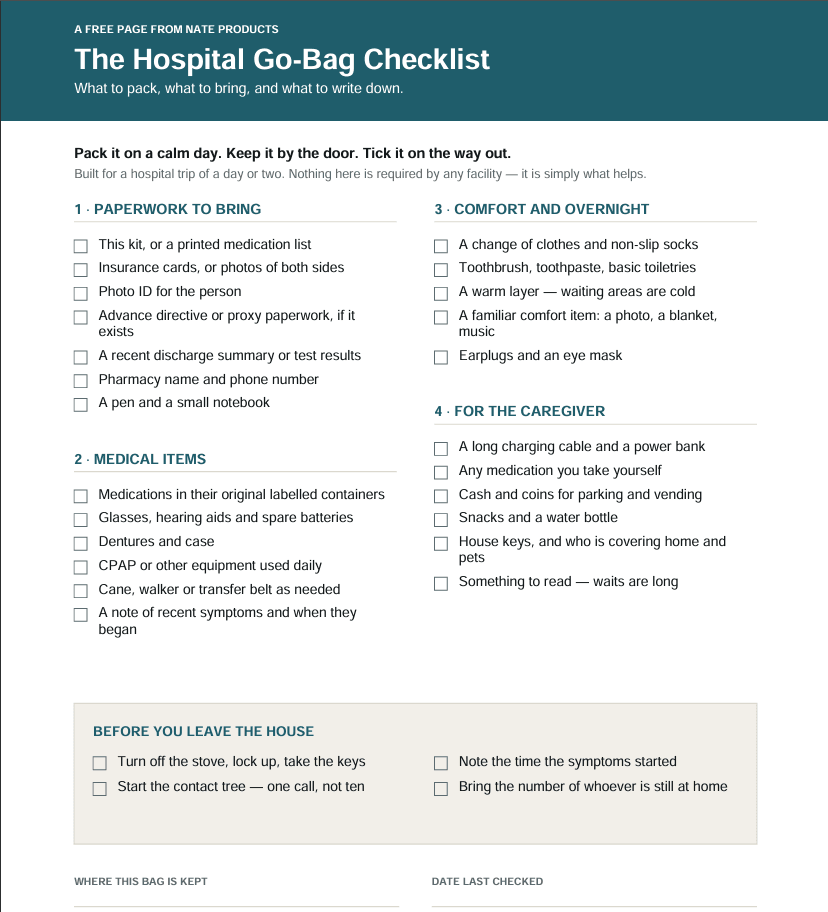
How to use it
Fill the first part in on a calm day. It takes about ten minutes, and it is the part nobody can do while a phone is ringing and someone is asking for an insurance card.
Print it, put it in a folder by the door, and tell one other person where that folder is. A checklist only one person knows about is still a checklist only one person can use.
Pack now, while nothing is happening
A folder or a bag that lives by the door.
- Photo ID, and the health card or insurance card. Photograph both and keep the pictures on a phone as backup.
- A printed medication list: name, dose, how often, and who prescribed it.
- Allergies, and what each reaction looks like.
- Ongoing conditions, past surgeries, and any device such as a pacemaker or CPAP.
- Phone numbers for the family doctor, the pharmacy and each specialist.
- Two people to call, and the name of whoever speaks for the patient if they cannot speak for themselves.
- A note of where the originals live: advance directive, power of attorney, insurance policy. Where they are kept, not the account numbers.
- A long phone cable and a charged power bank.
- Spare glasses, hearing aid batteries, and a case for dentures.
- A pen and a small notebook.
Grab on the way out
The part that gets forgotten, because it is the part you do while rushing.
- The folder above.
- Current medication bottles, or a photo of every label.
- Phone, charger and the power bank.
- Glasses, hearing aids, walker or cane.
- A warm layer. Waiting rooms run cold.
- Water and something to eat for whoever is waiting.
- Coins or a card for parking.
Write down while you are there
You will not remember it afterwards, and the next person to ask will be someone else.
- The time you arrived, and the reason given for the visit.
- The name of the doctor or nurse in charge, and the unit you are on.
- Every test done, and what it showed.
- Any medication started, with the dose and the reason for it.
- Anything that was stopped, and for how long.
- The plan, and what has to happen before going home.
- Who to call with a question, and when results are expected.
Before you leave
Ask for these while someone is still in the room.
- Written discharge instructions, and a number to call after hours.
- Any new prescription, and whether the pharmacy already has it.
- Which follow-up appointments are booked, and which you have to book yourself.
- The warning signs that mean coming back.
- What to stop doing, and for how long.
What this is, and what it is not
This is an organizing tool. It is not medical, legal or insurance advice, and no hospital is required to accept or use it. It exists so the information is ready when someone asks for it. In an emergency, call your local emergency number first.
Where the Kit helps most
Three things the full kit settles that one checklist cannot.
Sibling arguments
Tired of arguing with your brother about who makes the decisions? Use the Role Map to assign roles instantly.
Hospital overwhelm
Walk into the ER knowing exactly what to ask the doctor. No more blank stares.
Spreadsheet fatigue
Ditch the messy Excel sheets. One set of pages for medications, contacts and where the paperwork lives.
If you want the rest of it
The Family Care Coordination Kit includes a fillable version of this checklist, plus the parts that are harder to assemble in a hurry: who is responsible for what, the emergency contact tree, a medical snapshot, and a locator for insurance and key documents. 11 pages, Fillable PDF + Companion Google Doc, $18.99 USD.